
Solar vs Mains Outdoor Wall Lights: What to Confirm Before Ordering
Compare charging conditions, operating requirements, installation and catalogue options before choosing a solar or mains outdoor wall light.
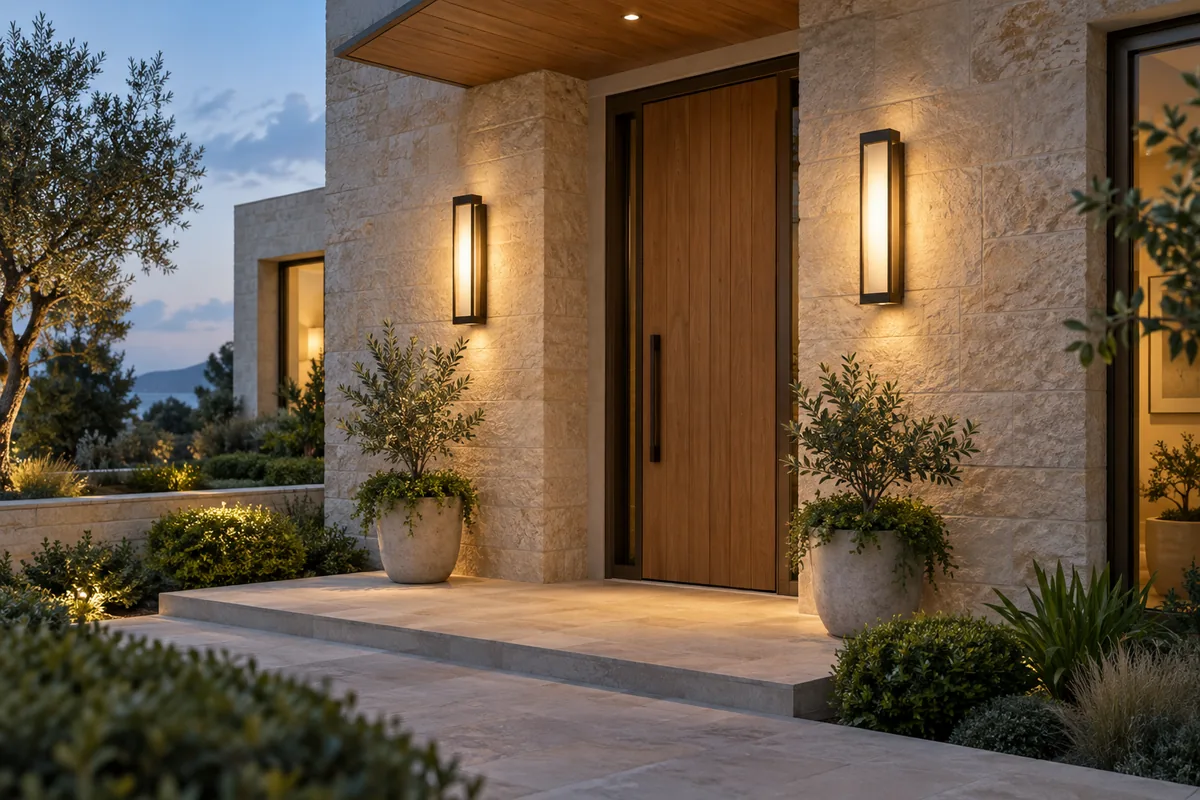
A solar wall light and a mains wall light can share an exterior design while requiring different planning. Start with where the light will operate, how long it needs to run and what power is available. Then compare the exact configurations, rather than treating a shared model photograph as proof of identical performance.
1. Record the site and required operating hours
Photograph the mounting position during the day and note roof overhangs, trees and nearby buildings. Solar generation depends on sunlight reaching the panel; storage allows energy collected earlier to be used later. The US Department of Energy describes both the effect of shading and the role of storage. Those principles do not establish the operating time of a particular catalogue light.
Write down whether the light is decorative for a few evening hours or needed throughout a defined period. Ask the supplier to check that requirement against the selected panel, battery and operating mode. Leave runtime marked as unconfirmed until you receive model-specific information.
- Installation city and wall orientation
- Photographs showing possible shading and panel location
- Required hours and preferred switching behaviour
2. Compare the right questions for each power option
For solar, request the panel location, charging requirements, battery specification, operating modes and replacement arrangements. Clarify whether the panel is part of the light or a separate component and what is included in the quoted configuration.
For mains, provide the site's supply and proposed switch, timer or sensor details. Ask the installer to assess the cable route and mounting position. A mains SKU and a solar SKU should remain separate lines on the order, even when their housings look alike. Neither power choice automatically establishes weather suitability; request the selected fitting's protection documentation.
3. Read the HAOFLUX option labels carefully
LTJ-JBD08 and LTJ-JBD04 list coffee and black options with both solar and mains configurations. HF-3881 lists coffee-colour flat-top options with 400, 600 and 800 labels for both power types. These are examples of separate orderable configurations, not an assurance that their output or operating hours are the same.
Some original size labels omit a unit. Ask for a dimensioned drawing rather than assuming centimetres or millimetres. Include the full SKU in your enquiry so a quoted price is attached to the correct power option, finish and body size.
4. Compare installation and maintenance as well as price
Request the included-component list and ask how the battery, light source or driver is serviced for the chosen version. For a row of lights, consider a sample in the proposed position before ordering the full quantity. Record the sample's operating mode and the conditions under which it was reviewed.
HAOFLUX's listed configuration prices are product selling prices; freight is quoted for the destination. Confirm availability and any separate accessories before comparing total orders. Send the model, quantity, site photographs and required operating hours to xue@haoflux.com. This is a purchasing checklist; the installer should determine the final electrical installation.