
How to Choose Outdoor Wall Lights for Entrances and Facades
A practical outdoor wall-light checklist: installation exposure, documented IP rating, materials, glare, mounting details, controls and information to send for a quotation.
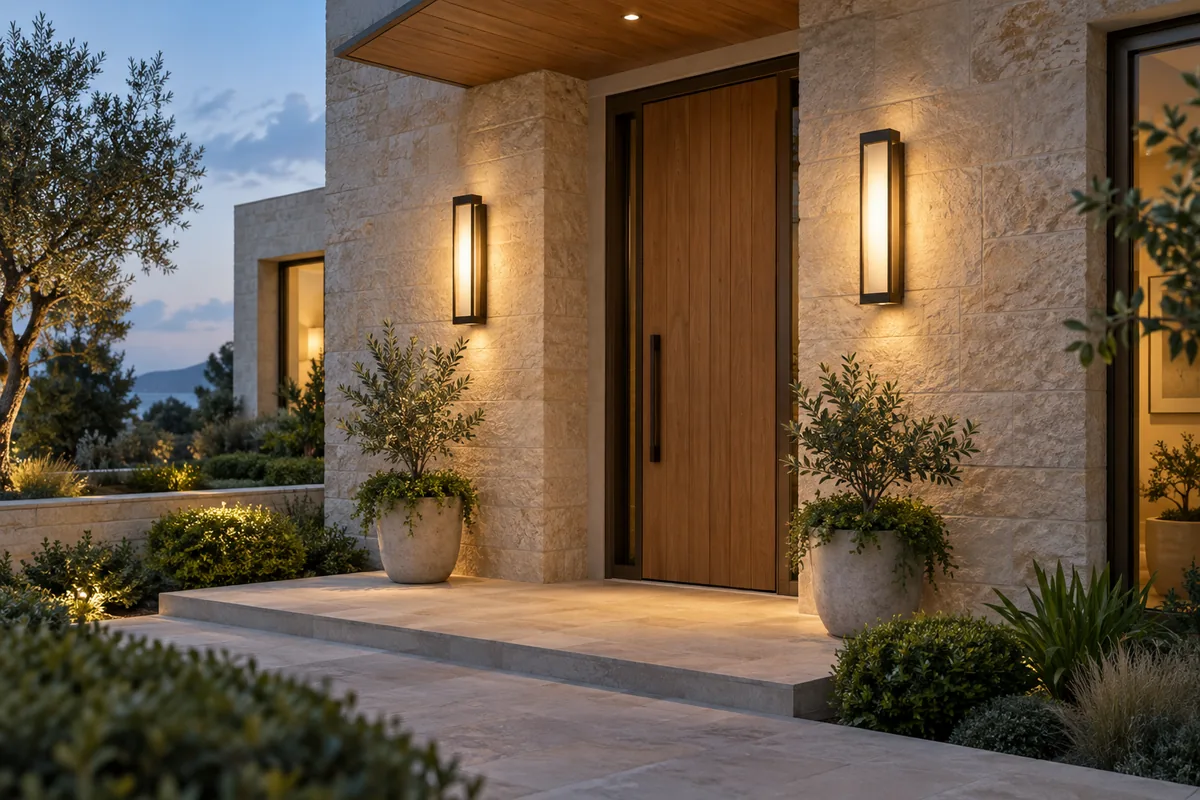
Start an outdoor wall-light enquiry with the installation environment, not just a preferred style. A sheltered doorway, an open garden wall and a coastal facade expose fittings to different conditions. Shortlist a design, then request the technical information for that exact model and configuration. A product photograph cannot prove weather suitability, light output or the quality of its protective finish.
1. Describe where the light will be installed
Tell the supplier whether the fitting sits under a roof or directly in the weather. Include photographs showing the wall, roof overhang, nearby planting and the intended cable entry. Note whether the site is coastal, regularly washed down or exposed to irrigation spray. These details help identify questions that a simple ‘outdoor light’ label leaves unanswered.
Treat the mounting orientation as part of the specification. A fitting suitable for one position should not automatically be installed sideways or upside down. Ask for the manufacturer’s installation instructions and have the installer assess the actual location, including how water is managed around the fixing and cable entry.
- Covered or exposed position, wall material and proposed orientation
- Rain, irrigation, cleaning practices and coastal exposure
- Available cable entry and access for installation and servicing
2. Request the model’s documented protection rating
The IEC 60529 IP code classifies enclosure protection. Request the declared IP rating and relevant documentation for the specific fitting you intend to buy, rather than applying a rating from a visually similar product. The appropriate specification depends on the installation conditions and applicable requirements, which the project’s qualified installer should assess.
Do not use an IP number as a substitute for information about materials, finish durability or maintenance. Ask separately about the housing, fasteners, surface treatment and any conditions or exclusions that apply at a coastal or otherwise demanding site. HAOFLUX’s catalogue images and the illustration on this page do not establish an IP rating or certification for every model.
3. Review the light distribution and glare
Decide what the fitting needs to illuminate: the door handle and threshold, a house number, a section of textured wall or the approach to the building. A decorative glowing shade and a directed beam produce different effects. Ask for available light-output and distribution information, then review the fixture from the positions where people will approach, sit or look out of windows.
Consider spill light onto neighbouring property and direct views of a bright source. More power does not necessarily make the entrance more comfortable. Compare light output in lumens and ask about colour temperature and shade or optic options. The US Department of Energy’s guidance explains that colour appearance and colour rendering are separate aspects of lighting quality.
For a repeated row of fittings, review a mock-up or project-specific lighting design before committing to the spacing. A single attractive close-up cannot show whether a complete facade will have dark gaps, distracting bright spots or excessive glare.
4. Check dimensions against the actual doorway
Mark the proposed body outline on a photograph or elevation of the wall. Check the overall height, width, projection and mounting-plate dimensions against the door frame, columns and nearby trim. Confirm that an outward-opening door, shutter or gate will not strike the fitting.
Record the mounting location with the project team before cable positions are finalised. Choose a height and layout that fit the entrance and local requirements; a single universal mounting height is not suitable for every property. For natural stone or decorative wall finishes, coordinate the fixing and cable route with the installer so the finish is not damaged by late changes.
5. Coordinate power, controls and maintenance
Confirm the supply voltage, frequency and whether the fitting uses replaceable lamps or an integrated LED module. If using a timer, sensor or dimmer, provide the intended control details and ask for explicit compatibility confirmation. Do not assume every LED fitting supports dimming or that every sensor can be added to the same configuration.
Ask how lamps, drivers, glass and seals can be accessed or replaced, where replacement components are available and what cleaning method is recommended. Plan regular inspection with the property’s maintenance team. Electrical installation and servicing should follow the supplied instructions and be carried out by qualified personnel; this guide is a purchasing checklist, not a wiring manual.
6. Build a clear order and delivery brief
Send the selected product code, quantity, finish, dimensions, site photographs and delivery destination together. If several facade zones use different configurations, list each zone separately. Request a written confirmation of the exact specification and any required supporting documents before ordering.
At HAOFLUX, listed configuration prices are selling prices, while shipping is quoted separately for the destination. Both stock and made-to-order items are supplied, so availability and timing need to be confirmed for the selection. Quality-related returns or exchanges are accepted under the published policy; change-of-mind returns are not. No general delivery charge, stock promise or protection rating should be inferred from this guide.
For an initial selection enquiry, email xue@haoflux.com or use the contact page. Include the environment and technical requirements even if you are buying only one or two lights: a small residential order still benefits from an accurate specification.
- Model code, finish, quantity and preferred dimensions
- Site photographs, exposure conditions and mounting details
- Required technical documentation and electrical/control details
- Destination and preferred timing for delivery
- Any open specification questions that need confirmation